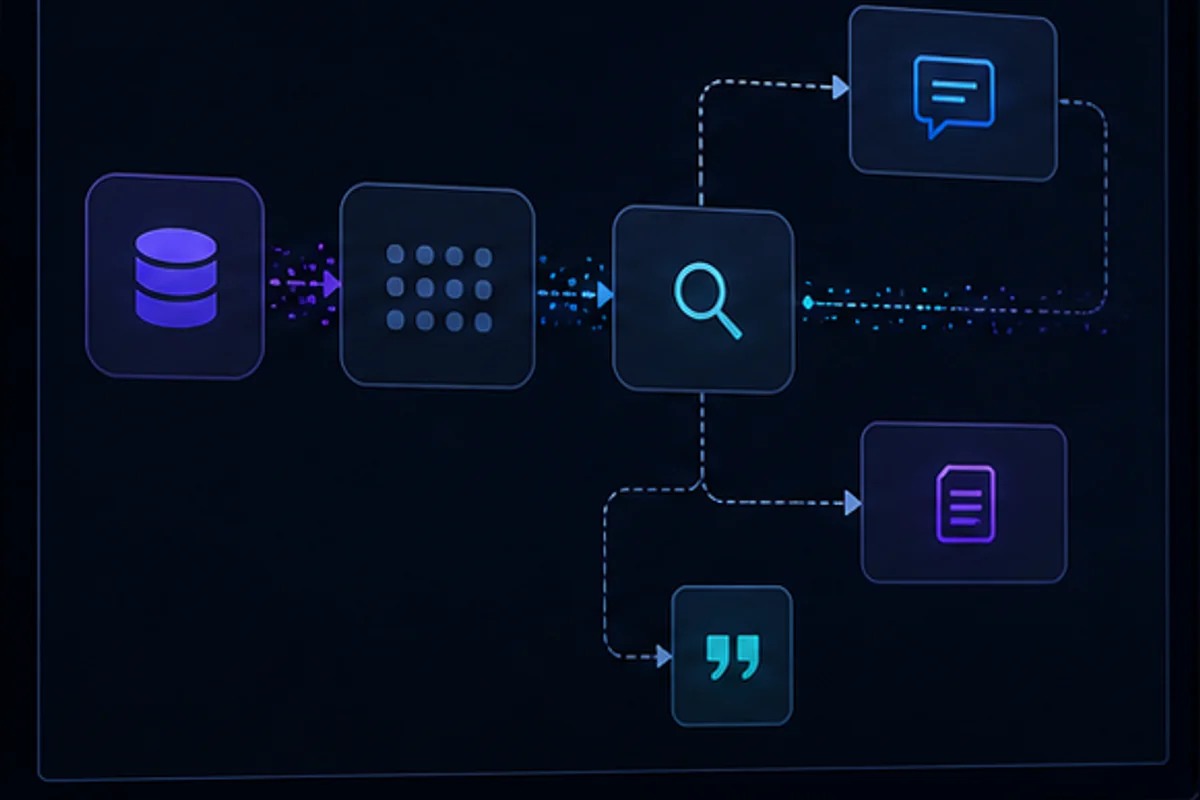
Retrieval can give a model relevant context, but it does not guarantee that the answer follows that context or that the cited passage supports the claim. AIPilotera uses task evidence instead of vendor rankings. This independent launch guide has no paid placement, names no preferred provider and links only to related guidance inside the project.
Define the task, people and consequence
Define the authorised corpus, document owner, update process, access controls, query types and the answer behaviour when evidence is absent or conflicting. State who supplies the input, who relies on the output and what happens if it is wrong. Separate drafting, recommendation and execution because each requires a different control.
Write success, partial success, failure and required refusal before testing. Include language, format, accessibility, time, cost and evidence requirements. High-impact tasks need stronger validation and qualified human accountability; some uses should remain outside automation.
Map data and system boundaries
Trace prompts, files, retrieved context, logs, tools, derived output and external side effects. Classify every data object and minimise it. Confirm account, region, retention, support access, deletion and training controls for the exact service and feature.
Use test or synthetic data until the processing path is approved. Never place credentials, private keys, medical records, financial identifiers or confidential client material in an unapproved trial. Availability of a feature is not permission to use sensitive data.
Criteria that change the decision
Corpus quality
Remove duplicates, obsolete material and documents without ownership. Preserve dates, jurisdiction, version and access metadata. Record the exact configuration, evidence and reviewer decision. Repeat variable behaviour and preserve the conditions that produced each result; a capability claim without a reproducible task and failure rule is not an evaluation.
Segmentation and context
Split documents without losing headings, tables or relationships. Evaluate whether retrieved context includes the decisive passage, not merely related words. Record the exact configuration, evidence and reviewer decision. Repeat variable behaviour and preserve the conditions that produced each result; a capability claim without a reproducible task and failure rule is not an evaluation.
Access enforcement
Apply permissions before retrieval and at every derived cache or index. Do not rely on the model to ignore restricted passages. Record the exact configuration, evidence and reviewer decision. Repeat variable behaviour and preserve the conditions that produced each result; a capability claim without a reproducible task and failure rule is not an evaluation.
Answer grounding
Require supported claims, useful citations and explicit absence when the corpus lacks an answer. Test adversarial instructions inside documents. Record the exact configuration, evidence and reviewer decision. Repeat variable behaviour and preserve the conditions that produced each result; a capability claim without a reproducible task and failure rule is not an evaluation.
Citation verification
Open cited passages automatically where possible and sample them manually. Measure claim support separately from answer style. Record the exact configuration, evidence and reviewer decision. Repeat variable behaviour and preserve the conditions that produced each result; a capability claim without a reproducible task and failure rule is not an evaluation.
Run normal, adversarial and recovery evaluations
Start with representative normal tasks and freeze prompts, settings, tools and corpus versions. Repeat non-deterministic cases. Then test ambiguity, missing evidence, conflicting sources, instruction injection, excessive requests and disallowed actions. A safe system should fail clearly rather than improvise authority.
Finally, interrupt a tool, revoke access, change a document, lose a dependency and trigger the manual route. Verify that partial actions are reconciled and queued work can stop. Recovery is a product capability, not a note added after launch.
Keep humans in meaningful control
Place a competent reviewer before public, financial, legal, rights-impacting or irreversible effects. Show the original input, evidence, uncertainty, proposed action and differences from approved rules. The reviewer must be able to edit, reject, escalate and record a reason.
Human review is not a universal excuse for weak automation. Measure queue pressure, agreement and missed errors. Reduce or stop the workflow when reviewers cannot realistically inspect the volume.
Measure quality without false precision
Report task pass rate, critical failures and variation separately from latency, cost and user effort. Disclose evaluation size, dates, configurations and exclusions. Do not turn several unrelated metrics into one unexplained score or present a documentary exercise as a benchmark run.
Re-evaluate after model, prompt, tool, policy or data changes. Use a holdout set and retain a known fallback. Public model names and capabilities change; the internal task and acceptance rule should remain the durable reference.
Plan monitoring, cost and exit
Include tokens or compute, retrieval, tools, retries, storage, monitoring, incidents and human verification. Define rate, amount and recipient limits for actions. Keep logs useful but minimise sensitive payloads and align retention with the approved purpose.
Maintain export, manual fallback, credential revocation, rollback and provider-change procedures. Test the exit before dependence becomes critical. An automation that cannot stop safely is not ready to start.
Risk signals requiring stronger proof
- Restricted content enters a shared retrieval index. Pause the workflow until the boundary, evidence, approval or recovery path is explicit.
- A citation points to a related but non-supporting passage. Pause the workflow until the boundary, evidence, approval or recovery path is explicit.
- The system answers when the corpus has no evidence. Pause the workflow until the boundary, evidence, approval or recovery path is explicit.
A risk signal is not a vendor verdict. It means the workflow lacks a material control. Remove the task, narrow permission or add evidence before exposure expands.
Finish with an auditable decision record
- State the task, affected people and prohibited outcomes.
- Freeze a representative evaluation and acceptance rules.
- Map data, tools, permissions and human approvals.
- Test normal, adversarial and recovery paths.
- Record the trade-off, owner, review date and rollback.
A mature AI decision can be explained without hype: this system supports these tasks under these limits, produced this evidence, keeps this human accountable and stops through this route.